
The Return: Fathers, Sons and the Land in Between | Harvard Review Online
The Return: Fathers, Sons and the Land in Between | Harvard Review Online
Releasing the Porcelain Birds: Poems After Surveillance
Releasing the Porcelain Birds: Poems after Surveillance, Shearsman, UK, 2016. An interview on the BBC World News about the book: An interview about working with the files on NPR: PRAISE FOR …
Source: Releasing the Porcelain Birds: Poems After Surveillance
Finding Stability in Literary language
23 Feb 2017 10:21 AMSanda Ionescu (Administrator) Guest post from former GWG member, instructor and great friend Carmen Bugan, now living in the US. For a beautiful review of her latest coll…
Finding Stability in Literary language
23 Feb 2017 10:21 AMSanda Ionescu (Administrator)
Guest post from former GWG member, instructor and great friend Carmen Bugan, now living in the US. For a beautiful review of her latest collection of poetry, see here. You can buy her book here. Meanwhile, just sit back and enjoy this brief meditation on the redeeming power of language in literature.
 I have said elsewhere that today’s English language suffers, and I keep returning to that thought because the evidence is everywhere. Our language suffers from materialism, texting-talk, marketing-speak, slogans, an obsession with celebrity, a fear of ‘the other’. You could say it reflects our character which craves a fast answer for every want and constantly searches for the easiest way out, a quick scheme to get rich and a magical recipe to eternal youth. I wonder how much this contributed to the recent election, and more-over, to keeping in the White House a man who makes life-changing political pronouncements via Twitter. We are all better than that and deserve more than being tossed from one quick promise to another. We are capable of self-reflection. Signs of this abound in the endless stream of protests on the streets where you could feel America is more alive than ever before.
The English language itself has resources that could help us heal. One of these is stability of meaning expressed in fiercely beautiful words. I am returning to classics and here I want to quote an excerpt from Jack London’s The Call of the Wild, which I know will mean different things to different people:
‘There is an ecstasy that marks the summit of life, and beyond which life cannot rise. And such is the paradox of living, this ecstasy comes when one is most alive, and it comes as a complete forgetfulness that one is alive. This ecstasy, this forgetfulness of living, comes to the artist, caught up and out of himself in a sheet of flame; it comes to the soldier, war-mad on a stricken field and refusing to quarter; and it came to Buck, leading the pack, sounding the old wolf-cry, straining after the food that was alive and that fled swiftly before him through the moonlight. He was sounding the deeps of his nature, and of the parts of his nature that were deeper than he, going back into the womb of Time. He was mastered by the sheer surging of life, the tidal wave of being, the perfect joy of each separate muscle, joint, and sinew and that it was everything that was not death, that it was aglow and rampant, expressing itself in movement, flying exultantly under the stars and over the face of dead matter that did not move.’

Metaphorical as it is, literary language constitutes a major resource. The protests on the streets of this country, the loud town-halls that are becoming a force of nature, might be touching the nerve of life as ordinary people are feeling ‘war-mad on a stricken field and refusing to quarter.’ Maybe the spirit of America is Buck, ‘leading the pack’, ‘sounding the deeps of his nature’ harking back to freedom. Or maybe readers will find the resilient spirit of this country in other books, in other stories, in other metaphors, in other words equally filled with ‘the tidal wave of being’. In the current political situation, which is chaotic and mad, there are books which we can open and could open us and perhaps, for the moment, they could be our first aid by keeping us steady.
A Dylan Thomas thought
Here is an example of poetry as a celebration of language: ‘Poem in October’* by Dylan Thomas. I will only quote a few lines so that I do not break any rights rules:
‘My birthday began with the water-
Birds and the birds of the winged trees flying my name
Above the farms and the white horses
And I rose
In rainy autumn
And walked abroad in a shower of all my days.
High tide and the heron dived when I took the road
Over the border
And the gates
Of the town closed as the town awoke.’
Oh and here is memory:
‘….
And I saw in the turning so clearly a child’s
Forgotten mornings when he walked with his mother
Through the parables
Of sunlight ….’
I love the image of walking abroad in the shower of one’s days: the walking through time, ageing, each day a raindrop that falls as far as the cloud will shed it–think of raindrops on people’s cheeks, raindrops on wooden houses, on the grass. There is such a physical connection between the soul of the speaker and the soul of nature here, all embodied in this language that takes you flying. And then, I wonder, as I have young children, what’s it like for them to walk ‘through the parables/ of sunlight’? What a blessing this poem is!
*(lines quoted from the Norton Anthology of English lit.*Vol. F)
Old doors, new handles
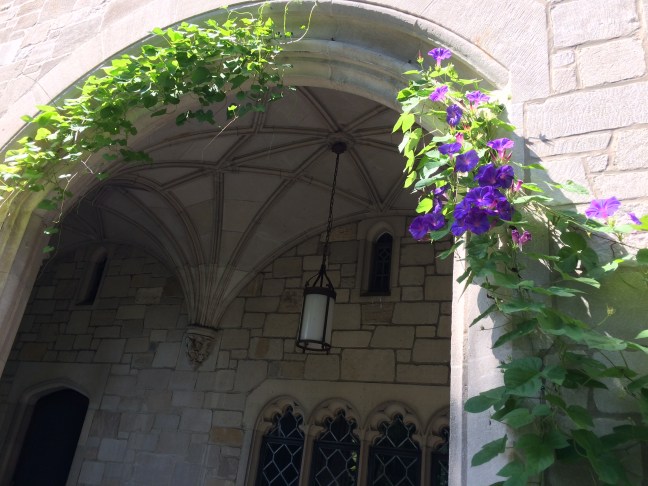 This past weekend my husband went around the house and changed all the door handles. These doors are over seventy years old, none of them close properly, and it seemed to me that new door handles, new door knobs for all the closets won’t make any difference. I advocated leaving the doors always open, this way we don’t have to deal with the handles! I teased him: ‘If you spent that much time updating our relationship, we’d be again just like newly married.’ He said, ‘That’s just exactly what I am doing!’
Then I started thinking about doors and handles. A good handle, a brand-new one might at least make you feel like you’ve updated something. The new handles replaced the old hand prints and the old memories, the traces of the other people who had lived here before, with something that now is ours. (We have updated the whole house, mind you, before we got to the doors, so let’s say that structurally the house works!) It feels good to grab into something that fits comfortably in your hand to open and to close the door. Maybe we are opening new things into our relationship too–at least the desire to make things work, to make them more comfortable.
Thinking about my marriage brought some lovely memories of my father who spent almost the entire time he was at home, trying to fix it. We children broke everything, he fixed everything, and nothing was ever too complicated for him to do, whether that was building a whole heating system or a brand new fence, which my sister and I used for gymnastics and as a volleyball net, with all the children on the street. I have no idea if my mother turned everything my father did around the house into metaphors but I have been doing this all my life, putting new words into old structures, like family, forever re-arranging feelings. The doors may still not open all the way or close properly in my writing either but at least we have a way to move them.
Our Children’s Snow
It’s coming into the end of the day. My daughter runs around the house, thumping from one window to the next, shouting at the rest of us to go see the snow, which began falling in thick layers. The grass is getting white, the little path from the door to the road is disappearing, the trees are whitening too, the roof of the house next door. I can tell by the bounce of her voice, the song she invents as she goes from one person to the next urging us to look outside, that her mind is recording the movement of the flakes, their dance. She switches languages as she runs from me to her father and back to her brother, her thoughts take off the runways of Italian and English filling the house with bright, melodious words: snow, guarda il cielo, pappa! At one point in her life will she remember this snow, this house, among her first memories? She is now at the age of first memories that become permanent.
My child is stirring my own first memories. When was my first memory of snow? It must have been at my grandparents’ house in another language yet, a language that calls the snow with the word zapada. I must have been wearing socks knitted by my grandmother to keep me warm against the cold of the clay floor covered by a straw mat. We must have looked out of the small kitchen window through the stars made of ice that clung there most of the harsh winters. I walk to the window and look through this snow, at the snows to come, the hope of the many snows to come, for my daughter, and for me. There is something oracular about tonight’s snow, or let me say that I earn for something oracular in tonight’s snow…
Reading Plans for 2017: The EU 27 Project

All of last week I’ve been catching up with reviews of books that I read in December and over the holidays, but what are my reading plans going forward?
Initially, I was going to take it easy in 2017. I dropped my Goodreads challenge to 120. [Yes, it sounds like a lot, but I’ve been reading between 155-180 for the last few years.]
The physical and electronic TBR piles are intimidating – almost a health hazard! So I’ve joined the TBR Double Dare Challenge of reading only from the books I already own for the first 3 months of the year. After single-handedly subsidising the publishing industry for the past 4 years, I resolve to buy no new ones for several months. Of course, that doesn’t include books I receive for review on Crime Fiction Lover and other sites, but no more novelties or even ARCs on my own blog.
I’ve already cheated slightly…
View original post 513 more words
 Dr. Carmen Bugan--Poet, Scholar, Teacher